We do have some information from other relatives about the gardener’s (aka my husband’s) maternal history, but it will need more work in the future. For now, we want to focus on his paternal relatives because we know so little of them.
I wrote to the gardener’s cousin and asked if he had any documents passed down in the family. Unfortunately, he does not. At some point, anything that would help in researching the family history was thrown away or lost.
But I started to think that since both his paternal grandparents immigrated to this country and died here, that the cemetery and their headstones would be the first step.
They are both buried at Montefiore Cemetery in Queens. I was able to confirm that on Find-a-grave. I asked our cousin to take photos of the headstones because I didn’t think it was a good idea to ask my daughter who is not familiar with areas of NYC outside where she lives and works–and she has no car. He was very willing, but then Sharon from Branches of our Haimowitz Family Tree told me that I could just ask the cemetery to take the photos for me for $10! So much easier. It turned out to be quick, too, because the photos showed up in my mailbox seemingly instantaneously. Thank you to Carl!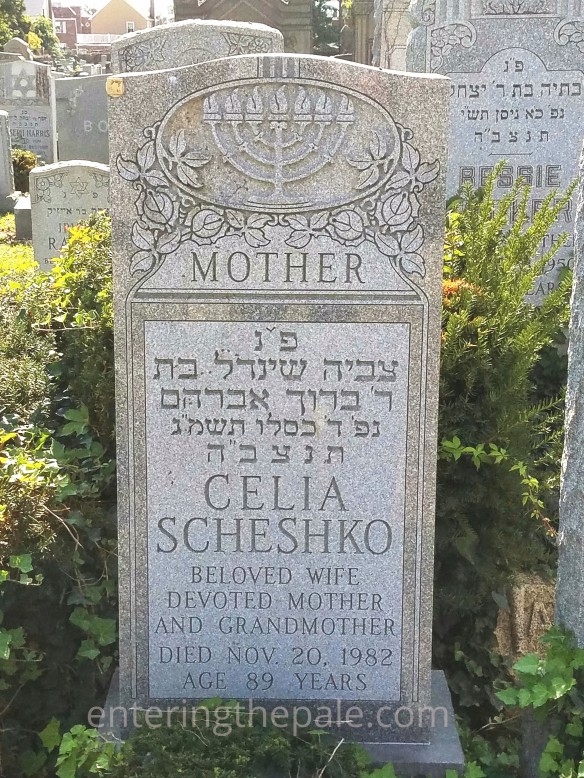
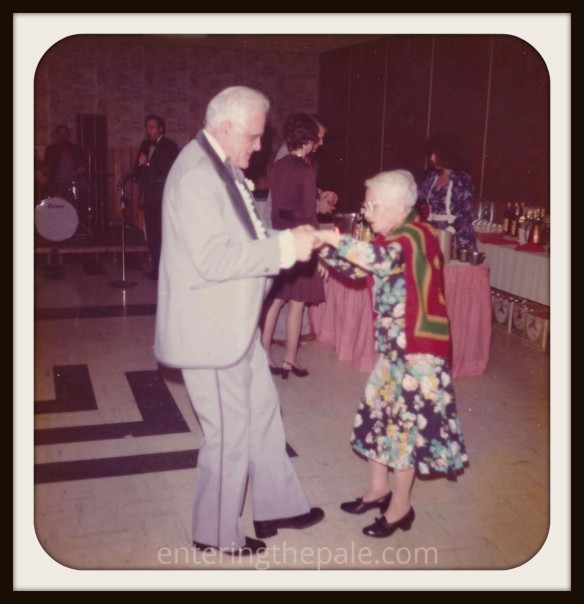
I knew Celia because when the gardener and I got married she was elderly. She traveled from NYC to Michigan for our wedding and brought her own food with her as she was worried that she wouldn’t be able to get kosher food in Kalamazoo.
She was a tiny little lady. Here is a photo of her dancing with her son, my father-in-law Murray, at our wedding.
Since Isidore passed away in 1953, I wasn’t even born yet, so I never met him. But his presence was always a part of the family that I married into.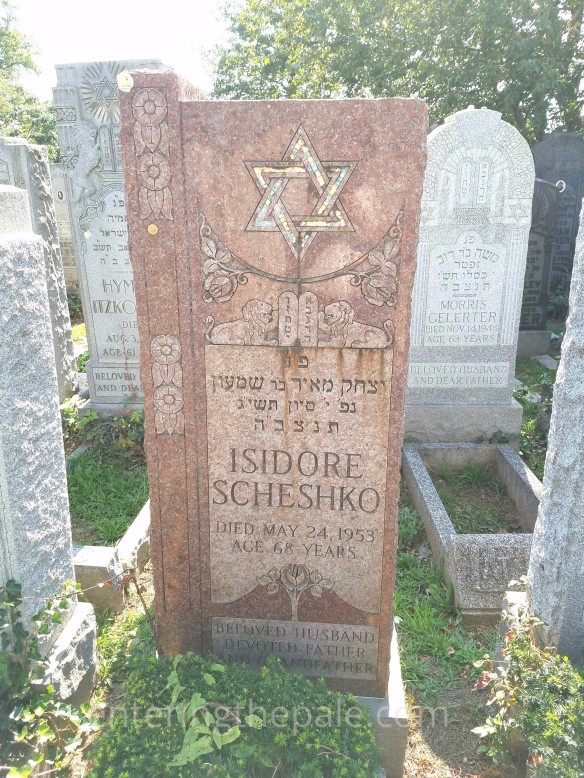
I think these are extraordinarily beautiful headstones–the details are marvelous.
What did we learn from the headstones? We already knew their names and the dates they died. But we might have learned the year they both were born–Isidore’s by taking 1953 and subtracting his 68 years and hers by taking 1982 and subtracting her 89 years. Time will tell if we are right.
By translating the Hebrew we have learned that his father was listed as Shimon, and that Isidore’s Hebrew name was Itzchak Meir (my husband was named for him).
Celia’s Hebrew name was Tziviah Sheindel (Tzivia Shaindel). In fact, our daughter is named for her and for my grandmother–Miriam Shaindel. Several people translated the headstone, just to make sure. This is the one from a kind soul on a Facebook group.
Line 1, [abbreviation]: Here lies buried, L2: Tziviah Sheindel, daughter of , L3: Mr. Baruch Avraham, L4: died 4 Kislev 5743, L5: [abbreviation] May her soul be bound in the bond of life.
The “Mr.” is seen in the abbreviation resh (R) followed by what looks like an apostrophe. This is for the Yiddish word Reb (according to the translator above), which is a term of honor closest to mister. Remember in Fiddler on the Roof Tevye is sometimes called Reb Tevye?
It was very helpful to locate the headstones as an initial step, and I’m glad we tried what is closest at hand first. Having the names of the fathers will be a big help in searching in eastern Europe.

 Entering the Pale