Celia’s Uncle Max and Family

If you remember from last week (trying to sound like a TV show here), Celia was traveling to the United States to her Uncle Max in Brooklyn. But who was this Uncle Max?

A few years ago, the gardener and I tried to find Uncle Max through Ancestry, but we couldn’t find him, based on the information available at the time. All we had to go by was a copier copy of a photograph that cousin Charlotte had given us. The handwriting is Charlotte’s. We tried to match up the children in the photo with families on the U.S. census reports. Notice that Celia Goodstein is in the back row, second from the left.

This is what it says:

Taken in N.Y. Eileen’s mother [arrow pointing to Celia] her cousins [arrows pointing to the other girls in the back row]

This family were relatives on her side, not my mother’s.

Since Charlotte’s mother was Malka Scheshko (Molly Riskin), and since she was not related to this family, we had to assume that the family was from the Goodstein side of the family. What we didn’t know was what their surname was. This made it very difficult to search.

As luck would have it, Uncle Max was a Goodstein. The surname was Gutstein (Gudstein, Gutshteyn) before it was Goodstein. The man in the photo is Max Goodstein, the brother of Celia’s father. I love how she’s standing just behind his shoulder.

While Max’s immigration records have not yet been located, his wife, Neche Gutstein, and children Reisel, Iankel, Ettel, and Itzchok were on the passenger list from Liverpool to NYC: 11 July 1907. They traveled 3rd class.


On the manifest for SS Celtic, which sailed that day, the listing is:


Nuche Gutstein and children: Reisel, Iankel, Ettel, Itzchock (Neche?), and Golda

Notice that Golda, an infant, was not listed on the first document. What does that mean? It seems likely that Golda was born on the trip from Liverpool to NYC. Can you even imagine what Neche went through? And baby Golda, too. Makes me sad to think of how hard it was for them.

The name of the nearest relative in country whence alien came:

Mother? Gittel Gutstein K..skiy street Tiraspol, Russia

It looks as if it is possible that Max’s wife’s closest relative in Russia was Max’s mother Gittel Gutstein, located in Tiraspol! If this is the case, Celia’s grandmother’s name was Gittel Gutstein, and that would be the gardener’s 2x great-grandmother.
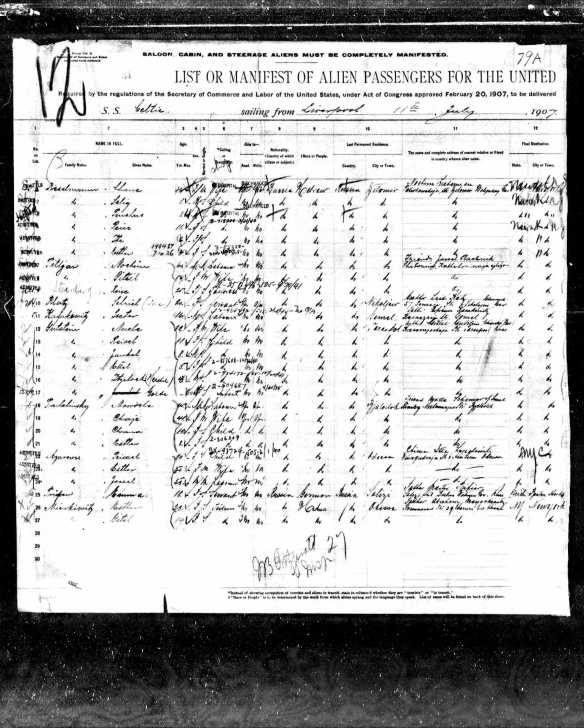
On this second page, it shows that Neche and children are joining her husband Max Gutstein at 349 Stone Avenue, Brooklyn, New York.

The next document is Max Goodstein’s Declaration of Intention to become a naturalized citizen from 1910.

This document gives some interesting information. For one thing, it gives his birthday as 6 March 1874, and states that he was born in Odessa, Russia! Again, Odessa! That means that both the Goodsteins AND the Scheshkos lived in both Odessa and Tiraspol. That seems like such a coincidence to me. Were there events that occurred that caused them to move from one place to other or back and forth? Maybe we will never know. If we can eventually map out a timeline, maybe it would be easier to research events.

Max was a tailor. He was also 5’6, so not a tall man. His 1910 Brooklyn address is listed. And, as of the filing of this document, Max was still a subject of Nicholas II, Emperor of All the Russias.That kind of makes me shudder.

On the 1910 census (so around the same time as the above document), Max Goodstein is listed at the 617 Sackman Street address of the declaration. His wife’s name is now listed as Anna, so Neche changed her name to Anna. The children are now Rose, Jacob, Ethel, Harry, Gertruda. They have all taken American names.

Look at the top of page 2 of the 1910 census. Nineteen-year-old Jennie Goodstein is listed as a daughter of Max and Anna! Celia must have tried out the name Jennie at the very beginning–or else her name was recorded in error.

So we have Celia now in the household of her Uncle Max and Aunt Anna. I wonder how comfortable she felt with them. She must have known them quite well from Tiraspol, so it wouldn’t have been as if she went to someone she barely knew–or didn’t know at all.

How did she get along with her cousins? Did they become like siblings to her? Or did they grow away from each other? Without a diary to read, some of these questions can never be answered. But I am always searching for clues.

To be continued again 🙂

Celia’s Story

Let’s move over to the gardener’s grandmother, the wife of Isidore Scheshko. Her name was Celia Goodstein Scheshko. What is her story?

The first document shows her leaving Hamburg for Liverpool. Her name is listed as Civie Gutstein. Of course, that would be an alternative spelling of Goodstein. Goodstein, if anything, looks to be an Americanized spelling. Where does Civie come from? We know from her headstone that her Hebrew name was Tziviah Sheindel (Tzivia Shaindel), so Civie makes perfect sense as a nickname–either how it was pronounced or how the agent heard her say it.

Notice on the above document where Civie was from. Tiraspol! Can you believe it?! All this time, the gardener had thought she was from Odessa and Isidore was from Tiraspol. But it appears that he was from both places and Celia had to be from Tiraspol. The gardener’s grandparents came from the same place? Nothing had ever been said about that–at least in the gardener’s hearing. (Relatives: if you have heard different about this or anything else, please let us know!)

The Ellis Island manifest gives a little more information about Celia.

The SS Caronia sailed from Liverpool on 13 November 1909 and arrived on 20 November 1909 at Ellis Island.

On page 1, it says: Gutstein, Civie 17 yo, dressmaker?,Hebrew from Tiraspol. The name of the nearest relative in the country whence alien came: Borukh Gutestein, Tiraspol, Russia. Final destination: Brooklyn, NY

On page 2, it says: Joining uncle, Max Gutstein in Brooklyn, NY 617 Sackman street.

Celia was detained until the next day after arrival because she was a woman, and the United States government required assurance that she would be provided for. She was being held to hand over, in effect, to her uncle Max who lived in Brooklyn.

These documents show that Celia’s path was from Tiraspol (in what was the Russian Empire and is now Moldova) to Hamburg and then traveling by ship to Liverpool and then to New York City where she was met by her Uncle Max.

If Celia was 17 years old when she immigrated in 1909, she would have been born in 1892. According to her headstone, she was born around 1893. And according to her social security application, she was born 15 Dec 1892. I would say it looks plausible that she really was born in 1892, and that she was 17 when she immigrated.

Another family story that is kind of scuttled by this info is that Celia was a young teen when she immigrated. She really was 17 years old, which is very young, but not a young teen. Of course, when I think of sending my 17-year old across the ocean to a new life and no way to communicate other than slow letters, it defies imagination.

To be continued . . . .

Malka Becomes Molly

Isidore Scheshko’s sister Malka arrived in the United States before anyone else in her family. Or did she? According to the ship manifest, she was coming to her uncle, Berl Silberberg.

Malka was listed on 9 November 1907 on the ship S.S. Patricia out of Hamburg. See Berl’s name on page 2.

The gardener and his cousin have not heard of Berl Silverberg. Was he the husband of the sister of Malka and Isidore’s father, Shimen? Or was he Khaya’s sister’s husband? The family story has always been that Malka and Isidore were the only family members to immigrate to the United States. I can’t help but wonder if Berl really was an uncle or perhaps a friend or ex-neighbor. What was the likelihood of that happenstance?

There were Berl Silberbergs in the United States in those days, but the correct one has not tapped me on the shoulder yet.

Malka was listed as a seamstress, which is very likely, although nobody has a recollection of a story about that.

On the departure record, Malke listed her surname as Schiskin. I read a fascinating article about name changes, and how, contrary to mythic lore, surnames were not changed at Ellis Island. However, a surname might be changed by the individual on the ship manifest when they left Europe. The only record Ellis Island officials used to check someone’s identity was the ship manifest!!! And once someone was “on the ground” in the U.S., he could change his own name without any legal requirement for recording or permission!

So, the question is: did Malke change her surname purposefully? or was her name misheard by the person writing in the ship manifest?

Here is the Ancestry transcription of Malke’s manifest documents. The birth year here is 1887, rather than the actual 1885.

One oddity about the name Schiskin is that, while it is an easy error from Scheshko, it is also a portmanteau name for Scheshko + Riskin. And look who she married!

On 2 May 1915, Malka married Isaac Riskin. She is listed on this marriage record for the State of New York as 24 years old. That means that when she arrived she was only 16, whereas the manifest lists her as 20. But her birth record in Odessa shows her born in 1885, which would mean she was 22 when she immigrated and 30 when she married. On some of the census records, she shows her birth date as 1888 and 1889. None of those ages is out of the realm of possibility, and since we know the birth record I would say that the other documents are in error, either accidentally or purposefully.


In the right hand column above, second entry from the bottom, you will find Malka and Isaac’s marriage record. Isaac was 29, a merchant living in Portchester, New York. Malka was now going by the name Molly which she would use for the rest of her life. She has no occupation listed, which I find odd since she would have had to support herself. She was also living in Portchester. What brought her to Portchester?

Parents are listed for both parties. Israel Riskin and Carmina (no surname listed) for Isaac. Samuel Scheshko and Ida (no surname listed) for Molly/Malka. Samuel and Ida for Shimen/Shimel and Khaya. The witnesses were Harry Kasper and Meyer Johnick.

I so wish we had a photograph of the couple. Alas, we don’t have any of Molly/Malka and Isaac. But we do have photographs of their one child, Charlotte, who eventually married the love of her life, Danny Vendola. They lived in Stamford, Connecticut, until they passed away in 1995 (Danny) and 2007 (Charlotte). There were no children from their marriage.

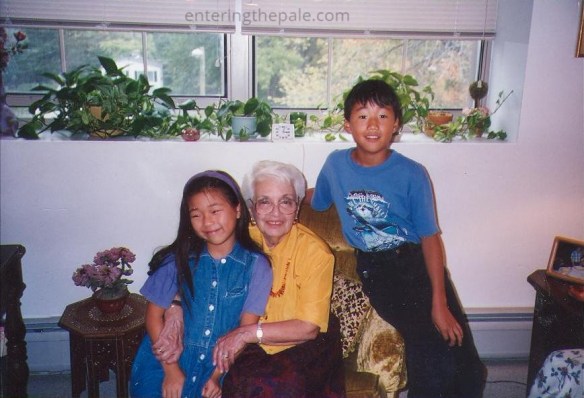
Here is a photo from when Charlotte was on her own after Danny passed, and we visited her with our children, perhaps in 1995 or 96.


An Heirloom from The Pale of Settlement

I’ve written a couple of posts about the tragic history of the Jewish population in the towns the Scheshkos were from.

Today I thought I’d share a light post.

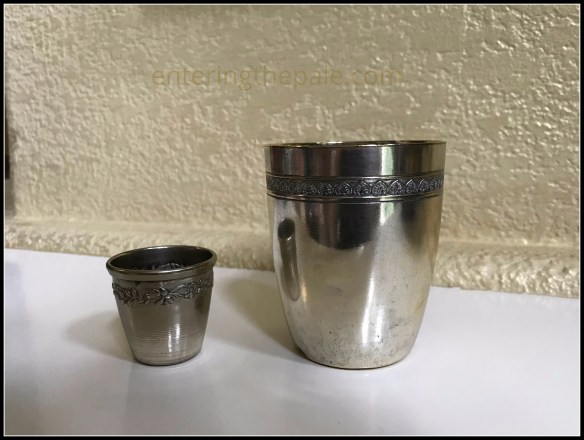
These kiddush cups came with Isidore when he immigrated to the United States.

I don’t think they are silver because they seem to be permanently tarnishing in parts. However, it’s possible that they are silverplate. I wonder if the base could be something called German plate, which is 60% copper, 20% nickel and 20% zinc, but I have no way of knowing. Best guess is some sort of silverplate as I have some silverplated objects from among my wedding gifts. The plating is probably wearing off

These two cups do not match, and they are not very ornate, although they each have a design engraved near the rim. I suspect that the larger cup has the tree of life replicated over and over, encircling it. The smaller cup has a design that looks like berries. Could they be grapes?

That they are the only objects we have that Isidore brought with him makes them very special.

A kiddush cup is used for the blessing over the wine for both Shabbat and for holidays. They’ve been used for many, many Passovers.

Do you have an heirloom that belonged to a branch of your family that you know very little about (the branch, not the heirloom)?

The Mysteries of Genealogy

Whenever you research genealogy and family history, there are mysteries. Sometimes solving mysteries means discovering new mysteries. But I think researching Jewish history means encountering more difficulties and, hence, mysteries than most other Western culture genealogy. The documents are difficult to locate–if they exist today at all. And there are obstacles all over the path toward success.

A mystery we have right now is where Celia Goodstein Scheshko was born and grew up before immigrating to the United States as a teen. The gardener was told by both his father and his father’s cousin Charlotte that she was from Odessa. There was no mention that she and Isidore might have come from the same city/town.

At first, Inna thought that Isidore probably was from Odessa and then his family moved to Tiraspol, moving back eventually to Odessa. This is based on addresses given on various documents. But finding Shimel Sheshko in Tiraspol during the famine in 1922 makes me think the family had stayed in or gone back to Tiraspol. The timeline is a mystery.

Still, if Celia was from Odessa, it would be clear that she and Isidore came from the same place. And if she were from Tiraspol, it would be the same situation.

There is a death record for Khaim, son of Borokh Gutstein, among Tiraspol cemetery records. Khaim was born in 1897, so if he were Celia’s brother it would make sense because she was born in or around 1892. According to Celia’s headstone, her father’s name was Baruch Goodstein.

The gardener took a DNA test with Ancestry, and I added it to FTDNA also. He has five matches for Goodsteins on Ancestry and four on FTDNA, but that doesn’t mean much of anything. The closest match is a match through his mother, not his father, so Goodstein is likely a coincidence. He has no Sheshko matches on either site.

Now here’s a DNA puzzle. I found a woman who has Sheshko lineage from Vasilishki. Later, Inna found the same woman. But there are no DNA matches between the gardener and this woman, a situation that is virtually impossible, given that Vasilishki was not more than a shtetl. Any Sheshkos would be related to each other.

It’s important to remember that with Jewish Ashkenazy DNA, there are many many matches, but they are very distant relations. Jews in the Pale of Settlement tended to marry within their own villages, even their own families, out of necessity. Inna explained that most of the gardener’s matches could only be found by tracing ancestry for both people back to the 1600s or earlier. This would be impossible. I know this sounds strange, but doesn’t that mean that it’s even more odd that he doesn’t have a DNA match with this woman? I am NOT good with the DNA science. It makes my head fuzz up inside.

I thought I’d leave you with images from Wikipedia of the Odessa Opera and Ballet Theatre building that was built in 1887, which is the same year that Isidore was born (also in Odessa). The gorgeous architecture shows you what a cosmopolitan city Odessa was.


Finding Names for the Photograph

In a very short period of time, Inna was able to get her hands on documents that would have taken me months to obtain.

First let me introduce you to Isidore’s Eastern European family.

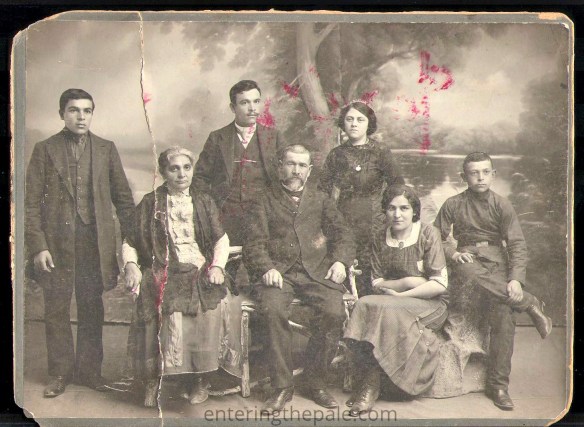
When this photograph was given to us years ago by Charlotte, the daughter of Isidore’s sister Malka (Malka had only one child and no grandchildren), all we knew was that Malka is not in the photograph because when it was taken she was already in the United States–and that Isidore is the one in the center in back. We, of course, assumed that the older couple were his parents.

Now, remember last week the birth list from Odessa? 

We saw Isidore (Itskhok-Meer) and Malka both on the list. We also saw a Scheshko whose name began with T, a Sura, a Mendel, and a Feyga Sosya. Sura and Mendel are listed as twins, and this seems to fit with the young man on our left and the seated young lady on our right. The T could be the standing woman.

So what did Inna find?

1885 Births, Odessa Rabbinate

Record #1420

Date: December 31, Hebrew date Shvat 6

Daughter: Malka

Father: Lida meschanin[1] Shimel son of Mendel SHESHKO

Mother: Khaya Brana


1887 Registry book of births, Odessa

Record #147

Date: January 26, 1887 Hebrew date: Shvat 13

Son: Itskhok-Meer

Father: Vasilishskiy Meschanin, Shimel son of Mendel SHESHKO

Mother: Khaya


Book of Odessa Jews born in 1889

Record # 631

Date: May 14, 1889 (Hebrew calendar:  Iyar 25)

Daughter: Tema was born on May 13

Father: Vasilishskiy Meschanin, Shimen son of Mendel SHESHKO

Mother: Khaya


Metrical records book for Jews born in Odessa in 1891

Man Record #: 1379

Woman Record #: 1269

Twins:

Son – Mendel was born on September 3d, registered on September 5th, Circumcision was done on September 10th

Daughter – Sura was born on September 3d, registered on September 5th,

Father: Vasilisheskiy meschanin* Shimel, son of Mendel SHESHKO

Mother: Khaya

Metrical book for Jews born in Odessa in 1896

Record # 1741

Date: December 2, 1896 (Hebrew calendar:  Tevet 9)

Daughter: Feyga-Sosya

Father: Vasilishskiy Meschanin, Shimel son of Mendel SHESHKO

Mother: Khaya

* Meschane in Russian Empire represented poor town residents who did not qualify as merchants or civil servants.

SO IN THE PHOTO ABOVE, WE HAVE:

Standing: Mendel, Isidore, Tema

Seated: Khaya (listed as Ida on Malka’s marriage license), Shimel (listed as Samuel on Malka’s marriage license), Sura, and an unidentified boy

Is it just me or does the boy look photoshopped in?

Regarding Feyga Sosya, why is she not in the family photo? She was younger than the twins, so she would certainly be in the family photo if she was still alive and not away with other family. Maybe we will discover one day what happened to Feyga Sosya.

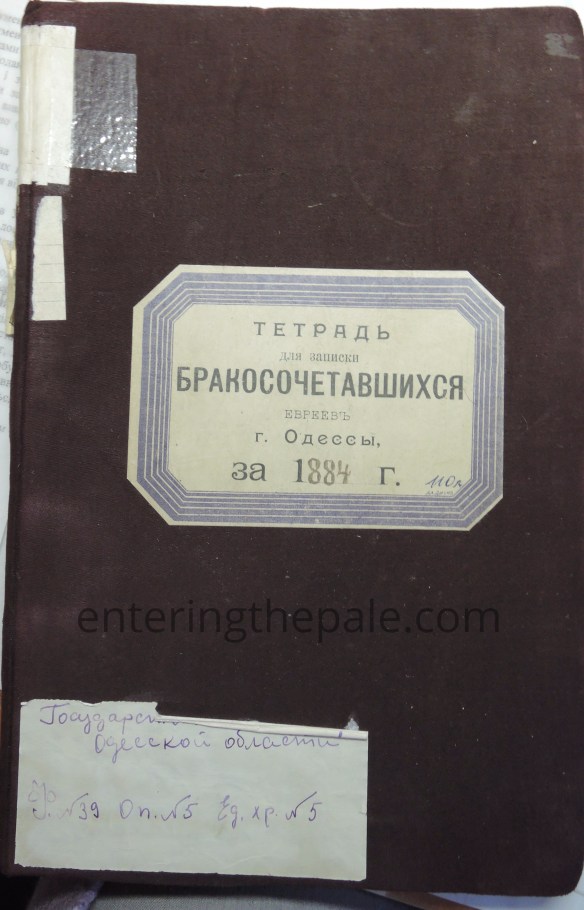
In the Odessa archives, Inna was able to find the marriage record of Shimel and Khaya.

Book of marriage records of Odessa Jews, 1884

Record #147

Groom: Vasilkovski meschanin Shimel SHESHKA, bachelor, 23 y. o.

Bride: daughter of Kupilskiy[1] meschanin Itsek Meer PECHNIK, Khaya, maiden, 24 y. o.

Marriage took place on February 20, 1884

[1] Kupil – Jewish settlement in Khmelnitsk province of Western Ukraine

So Khaya did come from Ukraine, and her maiden name was Pechnik, which is a wonderful addition to our accumulation of information and clues for further research.

Since the story was that Isidore didn’t know his birthday, it’s wonderful to see that there really was a record of his birth and those of his siblings. January 26 will always be the gardener’s grandfather’s birthday to me from now on.

Who Are These Other Scheshkos?

Here is a photo of Isidore and Celia Scheshko. I really love this portrait. It’s very small and wedged into the curved glass front frame for as long as I’ve known the gardener (and that’s a long time). I haven’t removed it to scan because I am afraid of damaging it. Any ideas on how to take it out carefully, with the hopes that I can put it back in the same frame? Alternatively, if a relative has this image scanned, please email it to me, and I won’t need to bother.

Although the gardener and I have only recently begun searching for his family history in a focused and determined way, for years we did stop by Ancestry looking for Scheshkos (grandfather Isidore) and Goodsteins (grandmother Celia).

Searching for the Goodstein family was very difficult because the name is relatively common and easily confused on documents with Goldstein, an even more common surname. Also, Celia traveled to the United States as a teen with her best girlfriend to live with her uncle. But we don’t have the name of the uncle–and we don’t think any other family members came to this country. We don’t even have the name of the girlfriend, although apparently, when they were elderly, they both lived together in a nursing home in the Bronx.

We had been told that Scheshko was not a common name, and that turned out to be true–at least in the U.S. We found a handful of other American Scheshkos, but they were apparently Christian and of no relation. We wondered if their family might have once been Jewish because we assumed it was a Jewish surname. In the case of Isidore, the only other family member who did come to this country (to our knowledge) was his older sister Malka who married, had one daughter, and no grandchildren.

I mentioned before that Celia used to get letters from the Soviet Union that had been shredded by the censors. The gardener and I always assumed that he had relatives behind the Iron Curtain. We even thought they might have been absorbed into the general population of that country during a period where religion was frowned upon.

Finally, at around the same time that I wondered about the grandparents’ headstones, I did a search on JewishGen, a genealogy website focused on Jewish history and ancestors.

There are 3 databases that revealed important information regarding the Scheshkos.

The first is a database that has been compiled of Jews who survived the Holocaust.

You have to understand where our brains were when we tried to process the idea that Scheshkos were anywhere near the Holocaust. For some reason, it never occurred to either of us that the Holocaust ravaged Ukraine and Moldova. We consider ourselves more knowledgeable about history than the average American. After all, it’s one of the gardener’s passions, and I have an undergraduate degree in history. In fact, one of my post-doctoral specialties was the Holocaust memoir, particularly written by those who had been children during those years.

But the Holocaust that I read about was always in Germany, Poland, Austria, France, Netherlands, and even Italy and Hungary. I suddenly realized I didn’t know much of anything about the 20th century history of the Pale of Settlement.

As I reread the list from Jewish Gen, I thought how the people didn’t seem familiar (how dumb is that?). But if Scheshko isn’t a common name, could they be shirttail relatives? We didn’t know. And where is or was Belice? I searched and searched and couldn’t figure it out. Eventually, we discovered it in the Grodno region of the Lida district in the country of Belarus.

A small detail of this list gave me pause, although I wasn’t sure if the gardener noticed it until I told him. I had found Isidore’s sister Malka (who became Molly in this country)’s marriage license (which I will produce in a later post)–and her parents were listed as Samuel and Ida. If Isidore’s mother’s name was Ida, was this woman in Belice his mother? I thought she was too old to have survived, but maybe it was another relative with her name–such as a niece of Isidore? Keep in mind that Jews customarily name babies with the name of a deceased ancestor, oftentimes a grandparent or great-grandparent. So if Ida, the gardener’s great-grandmother, had already passed on when a grandchild was born, the baby might share her name. This is strictly about Hebrew names, though, and Ida is not a Hebrew name.

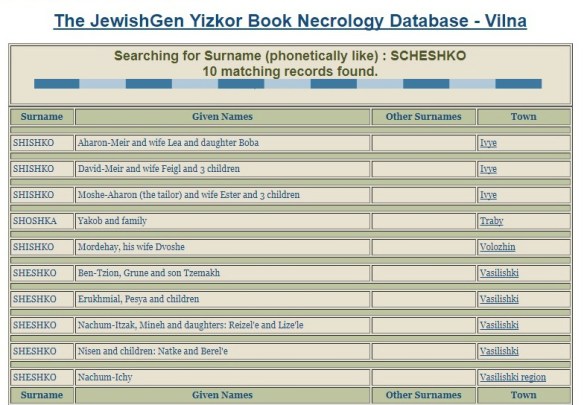
A second database undercut our hope about the first one because it was a list of Scheshkos who died during the Holocaust. Start reading halfway down this list.

While this list is for those from Vilna, some of the same people are listed in one for Grodno (like Belice). Notice that these people are from Vasilishki, a town in Belarus.

Belice and Vasilishki are very close, but Belarus is very far north from where the gardener’s relatives in the Black Sea region lived (Odessa and Tiraspol, as we had been told).

We were tempted to dismiss these other Scheshkos as family because we couldn’t imagine traveling so far (and for what reason) in those days unless you were actually immigrating to a place like the United States. That was our thinking.
All throughout the previous years and even in the beginning of this process this year we have been very naive. Just know that I can’t reveal all in one or two posts. There is too much information.

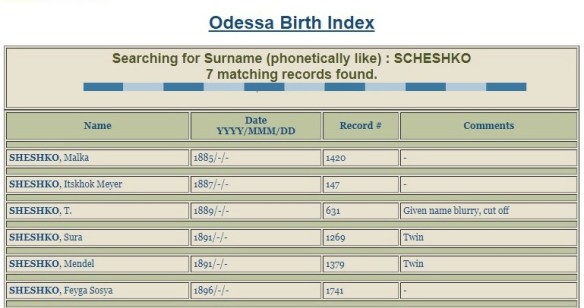
But I will show you the third database on JewishGen.

Look at that! Malka and Itskhok Meyer (just another spelling!), born in the right decade. But in the right city? The gardener had been told they came from Tiraspol, which is in Moldova. This database is for babies born in Odessa, which is in Ukraine. How can they be the same then? Maybe Scheshko was more common than we thought.
But I did a little Google research. Apparently, Tiraspol and Odessa are 65 miles apart and, in those days, Tiraspol would have been part of greater Odessa for government and other purposes.

At this point, I felt we had a serious lead, but I could not figure out a way to search for eastern European records, particularly those that were written in various languages completely unknown to me. I am used to wiewaswie, a website devoted to Dutch history. It translates into English, and the collection of Dutch documents available is astonishing. All very conducive to researching. But I was at a loss for how to proceed in Ukraine, Moldova, and even Belarus.

I contacted a few people on JewishGen and one person led me to another who led me to another. The gardener and I ended up hiring a smart and knowledgeable genealogist named Inna who specializes in this area. If you want to know how to contact her, please email me.

Inna was now able to take these lists from JewishGen, the headstones, and the few facts or maybe-facts that we had and begin a search abroad.

STAY TUNED . . . .

What is Closest at Hand?

We do have some information from other relatives about the gardener’s (aka my husband’s) maternal history, but it will need more work in the future. For now, we want to focus on his paternal relatives because we know so little of them.

I wrote to the gardener’s cousin and asked if he had any documents passed down in the family. Unfortunately, he does not. At some point, anything that would help in researching the family history was thrown away or lost.

But I started to think that since both his paternal grandparents immigrated to this country and died here, that the cemetery and their headstones would be the first step.

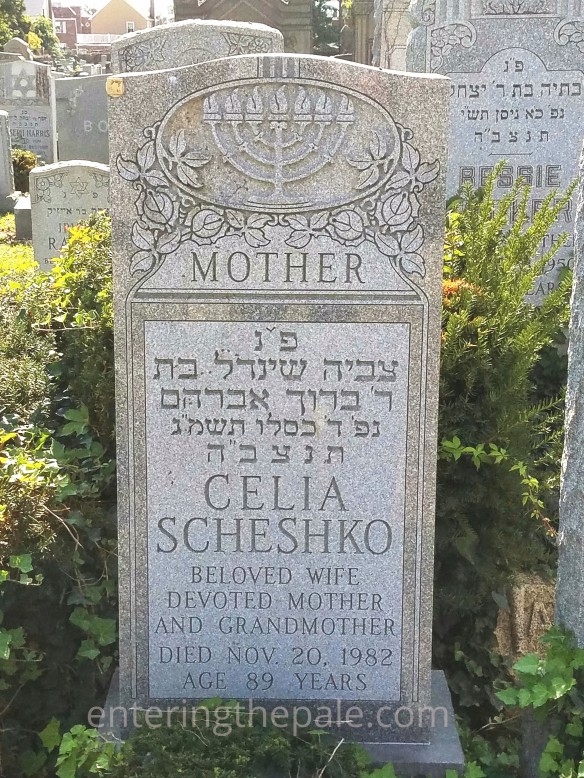
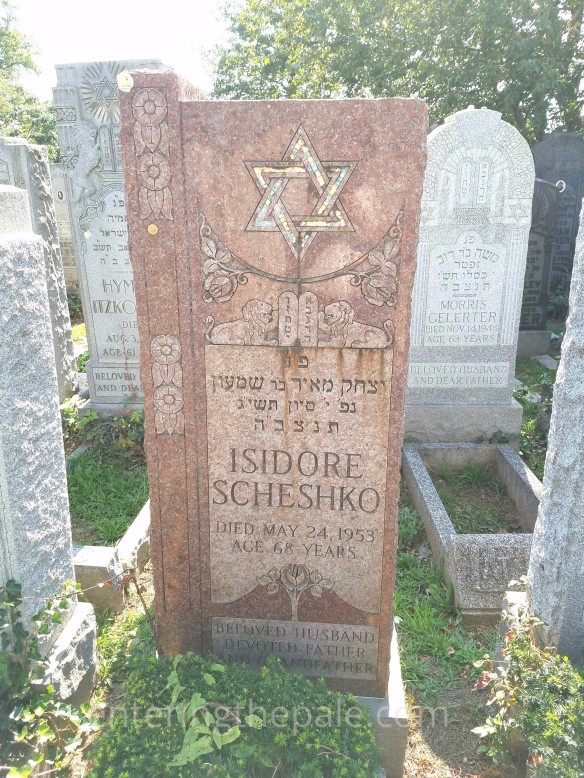
They are both buried at Montefiore Cemetery in Queens. I was able to confirm that on Find-a-grave. I asked our cousin to take photos of the headstones because I didn’t think it was a good idea to ask my daughter who is not familiar with areas of NYC outside where she lives and works–and she has no car. He was very willing, but then Sharon from Branches of our Haimowitz Family Tree told me that I could just ask the cemetery to take the photos for me for $10! So much easier. It turned out to be quick, too, because the photos showed up in my mailbox seemingly instantaneously. Thank you to Carl!


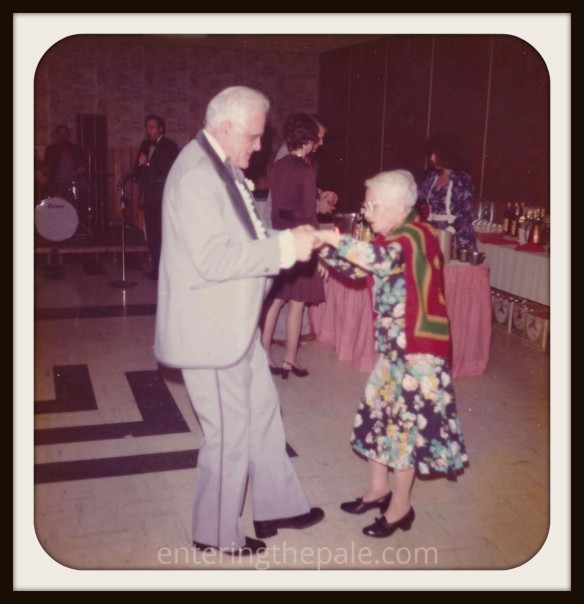
I knew Celia because when the gardener and I got married she was elderly. She traveled from NYC to Michigan for our wedding and brought her own food with her as she was worried that she wouldn’t be able to get kosher food in Kalamazoo.

She was a tiny little lady. Here is a photo of her dancing with her son, my father-in-law Murray, at our wedding.

Since Isidore passed away in 1953, I wasn’t even born yet, so I never met him. But his presence was always a part of the family that I married into.


I think these are extraordinarily beautiful headstones–the details are marvelous.

What did we learn from the headstones? We already knew their names and the dates they died. But we might have learned the year they both were born–Isidore’s by taking 1953 and subtracting his 68 years and hers by taking 1982 and subtracting her 89 years. Time will tell if we are right.

By translating the Hebrew we have learned that his father was listed as Shimon, and that Isidore’s Hebrew name was Itzchak Meir (my husband was named for him).

Celia’s Hebrew name was Tziviah Sheindel (Tzivia Shaindel). In fact, our daughter is named for her and for my grandmother–Miriam Shaindel. Several people translated the headstone, just to make sure. This is the one from a kind soul on a Facebook group.

Line 1, [abbreviation]: Here lies buried, L2: Tziviah Sheindel, daughter of , L3: Mr. Baruch Avraham, L4: died 4 Kislev 5743, L5: [abbreviation] May her soul be bound in the bond of life.


The “Mr.” is seen in the abbreviation resh (R) followed by what looks like an apostrophe. This is for the Yiddish word Reb (according to the translator above), which is a term of honor closest to mister. Remember in Fiddler on the Roof Tevye is sometimes called Reb Tevye?

It was very helpful to locate the headstones as an initial step, and I’m glad we tried what is closest at hand first. Having the names of the fathers will be a big help in searching in eastern Europe.


Entering the Pale for The First Time

When I was a kid, growing up in Michigan, there were two world powers: the United States and the USSR or the Soviet Union. In my mind, the USSR was RED for Communism and made up of Russia (where they had snow and vodka) and some other gray areas that never really took shape for me.

Map of Iron Curtain from Wikipedia

When I met my husband in high school, he said his grandparents were “Russian Jews,” and that their relatives were shut behind the Iron Curtain. He remembered his grandmother receiving letters from her relatives with more words cut out by censors than the number of words left in the letters. Today we wish those letters still existed, but at the time nobody thought to save them.

For years, we assumed that all records of these relatives were lost to time and war.

Not so, we are now discovering. And the reality of who his relatives were, where they lived, and what their lives might have been like seems to be different than our assumptions. But we are only beginning to learn about them. This blog is meant to share our findings with others who might be interested in the people of The Pale of Settlement.

Have you ever seen Fiddler on the Roof? If you’re like me, you probably assumed it took place in Russia because of the references to the Czar, the Russian soldiers, and the pogroms. The musical is based on the short stories of Sholem Aleichem who grew up in Ukraine, near Kiev. His stories are set in the area he knew best, thus Anatevka was in Ukraine! I’m not a history scholar of the area by any stretch of the imagination, so I could be wrong, but I imagine that is why the focus on the Cossack soldiers in the story. Cossacks are from eastern Europe–primarily, but not exclusively, Ukrainians. Of course, these lands were all under the Russian Empire at the time of the story.

***

As I explain about this blog in the About Entering the Pale page:

This blog is dedicated to researching family from a historical area of Europe known as The Pale of Settlement. This area included Belarus, Lithuania, Moldova, Ukraine, and parts of Latvia and Russia, extending from the demarcation line (known as the eastern pale) to the Russian and Prussian/Austria-Hungary border. The reason I call the blog Entering the Pale is that the Pale was an area where Jews were allowed permanent residency, as opposed to other areas of Russia. This is where the Scheshkos, Goodsteins, Pechniks, and others lived.

When I was a young history student, I was taught that the expression “beyond the pale” referred to the land east of the Pale of Settlement. Nowadays some people assert that the expression comes from an area of Ireland that was beyond the boundaries of England. In either case, the pale refers to the Latin word palus or stake. The land that is enclosed by a fence driven by stakes is a pale.